On September 30, Judge Amit P. Mehta of the U.S. District Court for the District of Columbia dismissed two antitrust lawsuits against Google in a single 41-page opinion. One came from Chegg, the online-education company; the other from Penske Media, joined in the suit by Rolling Stone, Variety, Billboard and six more of its properties. Both told a version of the same story: Google built a business on an implicit trade, content for traffic, and then unilaterally changed the terms once it had something, AI Overviews, that could keep users on Google’s own page. Coverage of the ruling converged on a tidy phrase: Google won because there was “no formal bargain.” That phrase doesn’t appear in the opinion. What the judge actually wrote is narrower and, for these plaintiffs, more final: “an expectation is not an agreement.”
It’s the same kind of gap a viral Slack quote left in a different unsealed filing a few weeks ago: the vivid phrase people share and the narrower thing a court actually ruled on turn out to be different documents. The distinction matters here, and so does something the coverage missed entirely. This was not the first time Judge Mehta had heard this exact theory from online publishers. It was the second time in six months he had rejected it, in an opinion that leans on his own earlier ruling almost like a worksheet.
The bargain, in the plaintiffs’ own words
“Fundamental bargain” is the plaintiffs’ phrase, not the court’s. Both complaints used it to describe how search was supposed to work: publishers let Google’s crawlers index their sites and feed their content into search results; in return, Google’s results page would send users back to those sites, where they could be converted into subscribers, ad impressions, and affiliate clicks. Chegg called this a “quid pro quo.” Penske’s filing used nearly identical language. Neither alleged a contract. Neither alleged a negotiation. What they alleged, when the judge pressed the point, was an “expectation”: that quality content, offered for free crawling, would keep being rewarded with search traffic, the way it always had been.
Google’s attorneys put it more bluntly in their own briefing: there cannot be unlawful reciprocal dealing when, as here, there is no deal.
The court agreed, and the reasoning has nothing to do with whether AI Overviews actually hurts publishers. Section 1 of the Sherman Act requires an agreement: “some meeting of the minds is required,” the opinion states, citing an 1891 edition of Black’s Law Dictionary alongside a 1999 Third Circuit case that uses the same phrase. Plaintiffs don’t need a signed contract to show one; courts have long accepted that an agreement can be implied from a “course of dealing.” But a course of dealing still has to carry the basic terms of a deal (price, quantity, duration), and Chegg and Penske pled none of that. Their own language gave the game away: they alleged they let Google crawl their sites “for an access price of zero.” An access price of zero is not evidence of a deal. It’s evidence that nobody negotiated a price at all.
The judge drew out what accepting the theory would require: a holding that Google has an implied contract with every website it indexes, since every indexed site makes the same bargain. Google’s own prior litigation put a number on that universe: by 2020, in the Justice Department’s separate monopoly case before the same judge, 89.2 percent of all U.S. general search queries ran through Google, which crawls trillions of pages. An antitrust theory that manufactures a contract with billions of counterparties on the strength of “we expected traffic” was never going to clear a motion to dismiss.
The same ruling, six months earlier
The wire coverage missed the part that matters most. In March 2026, two other publishers, Helena World Chronicle and Emmerich Newspapers, brought almost the identical claim against Google: a “monopoly broth” of conduct that turned Google into, in their words, “America’s largest news publisher,” built on the same uncompensated content-for-traffic exchange. Judge Mehta dismissed that case too, for the same reason. Those publishers’ claim of a “transactional arrangement” with Google was, he wrote in March, a “legal conclusion couched as a factual allegation” the court wasn’t bound to accept as true, a standard he borrowed from a 1986 Supreme Court case. In September, ruling on Chegg and Penske, he reached for the identical standard again: their “mere assertion that an agreement exists amounts to a legal conclusion couched as a factual allegation that the court is not bound to accept as true,” citing his own March ruling as the reason.
The July ruling in between matters too, because it shows the judge isn’t reflexively closing the door on Google’s content plaintiffs. Sensory, Inc. sued over something unrelated to publishing: exclusionary distribution agreements covering wake-word technology (“Hey Google”) on Android phones, spread across nearly a dozen alleged markets. That motion to dismiss was granted in part and denied in part. Some of Sensory’s claims survived. The difference is the legal theory, not the defendant or the judge. An exclusionary-agreement claim about a real commercial relationship between Google and device makers is a different animal from an implied, unsigned “bargain” inferred from the fact that crawling has always worked a certain way.
Why the tying claim failed on the plaintiffs’ own facts
Penske also tried a second theory that Chegg didn’t join: that Google illegally ties AI Overviews to general search, forcing users to take one along with the other. Tying claims have real teeth in digital markets: the D.C. Circuit’s 2001 Microsoft ruling, which both sides cited repeatedly, found that bundling Internet Explorer into Windows could be judged separately from ordinary product design. So this wasn’t a frivolous theory. It failed for a more interesting reason: Penske’s own complaint undercut it.
To win a tying claim, you first have to show the tying and tied products are genuinely separate: real, independent demand for each on its own. Penske argued at the hearing that general search and AI Overviews serve different purposes: search is “meant to take a user from one place to another,” while AI Overviews is “designed to keep someone on the search engine results page.” But that’s not what Penske’s complaint actually alleges happens. The complaint says a user satisfied by an AI Overview “will have little reason” to click through to the original site at all, which is a claim about one merged demand, not two separate ones. If people genuinely wanted the “go somewhere else” product and the “stay here” product separately, Google’s decision to place one on top of the other should have produced users scrolling past it to reach their real target. Penske alleged the opposite: cannibalization, not indifference.
The complaint also, without quite meaning to, conceded the “competitive fringe” problem. Penske’s own brief noted that DuckDuckGo bundles a GenAI summary at the top of its results too. Under the Microsoft precedent, when the entire competitive fringe of an industry does the same bundling the defendant does, courts treat the tying and tied product as one product by default. Bundling that widespread looks like how the product category works, not like coercion unique to the dominant firm.
Antitrust standing, a shape that doesn’t fit
The deepest problem in both complaints was standing, and it’s where the opinion gets almost mathematically blunt. To bring an antitrust claim over harm to the general search market, a plaintiff has to have suffered an injury in that market. Chegg and Penske’s actual claimed losses (declining subscriptions, declining ad revenue) are injuries in the market for digital publishing, not the market for search. Those are two different markets under their own complaints, which is exactly what let the court say the harm was “too secondary and indirect” to count, a standard borrowed from a 1995 Seventh Circuit case. The same injuries, the court added, quoting a 2020 Ninth Circuit opinion about Qualcomm, “though flowing from that which [allegedly] makes the defendant’s conduct unlawful, are experienced in another market.”
Plaintiffs tried to describe themselves as both suppliers of content and purchasers of traffic in the same transaction: selling Google their pages, buying Google’s referrals. The judge’s response, lifted almost verbatim from his own March ruling: search traffic can’t be both the good purchased and the payment for that purchase. “It cannot be both.”
What the market-definition claims ran into
Two more counts, monopoly leveraging and attempted monopolization, needed a plausible product market that Google was leveraging its search dominance into. Penske’s proposed market, “Online Publishing,” covered nearly all text published online: “news articles, periodicals, reports and any other types of information.” The court didn’t need much more than Penske’s own definition to reject it: a market broad enough to make a blog post, a legal brief, a short story, and Chegg’s own 135-million-item homework database into mutual substitutes doesn’t describe anything a court can work with.
Chegg’s narrower “Online Educational Publishing” market fared a little better on paper (curated, verified, pedagogically focused content), but ran into its own complaint from the other direction. Chegg had alleged that Google’s AI Overviews work by scraping and summarizing content with no curation or verification at all. If that’s true, the court noted, Google may not even be a participant in the market Chegg just defined, which leaves the claim nowhere to stand.
What the ruling doesn’t settle
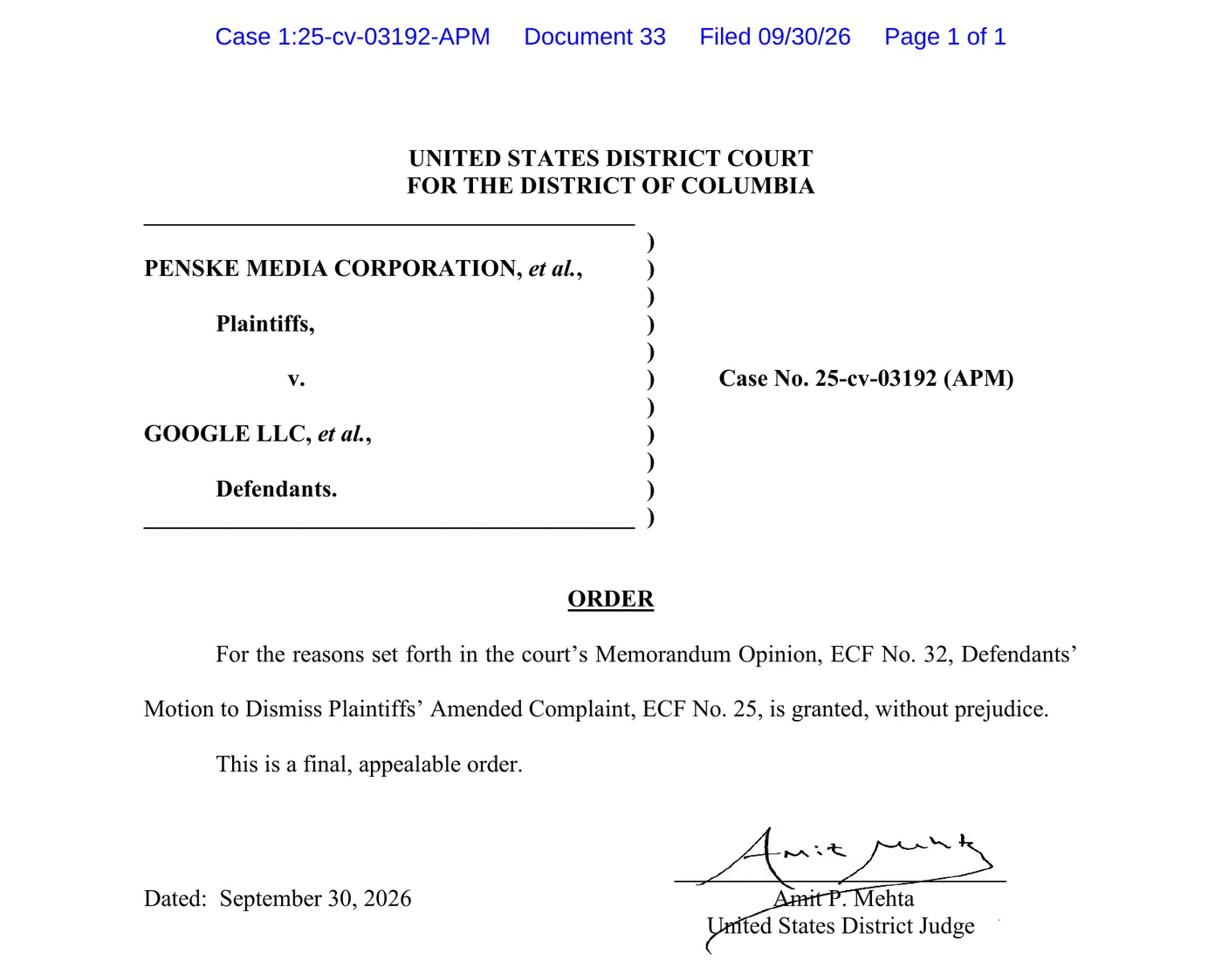
The dismissal was without prejudice. Nothing stops Chegg or Penske from trying to replead, the way Helena World Chronicle’s publishers could have after March. Neither Helena’s publishers nor, now, Chegg and Penske have shown they can plead an actual agreement into existence, because by their own account there never was one to point to. That’s the shape of the problem: the theory doesn’t fail because the judge doesn’t believe Google changed the deal. It fails because “the deal” is a metaphor the plaintiffs used to describe how search traffic has always worked, and a metaphor isn’t a contract no matter how many times you repeat it across two complaints and a hearing transcript. The same lesson showed up from the opposite direction in a Pentagon-contracting case decided last week, where two statutes read the identical conduct two different ways depending on which one actually applied: motive mattered under one, not at all under the other. Which door you walk through keeps turning out to matter more than what you did on the way in.
The legal defeat and the underlying grievance are different things, though. In the same SEC filing that disclosed its fourth-quarter results, Chegg told investors its non-subscriber traffic had “plummeted to negative 49% in January 2025, down significantly from the modest 8% decline” it had reported for the second quarter of 2024 (its own disclosed numbers, not independently audited, but filed with the SEC and offered as the reason it was suing). It laid off 45 percent of its staff that October. Google’s own response, when Penske filed its suit, came from spokesperson José Castañeda: “AI Overviews send traffic to a greater diversity of sites,” and the company would “defend against these meritless claims.” None of that got easier to live with because a judge found no contract. A study published this year in the Journal of Retailing and Consumer Services found that search users who can’t opt out of AI-generated summaries report feeling less in control and more likely to say they’d switch search engines. People notice the thing happening to them even when the law doesn’t recognize it as anybody’s broken promise. The commercial complaint and the legal one just turned out to be different shapes, and only one of them fit through the door the Sherman Act opens.
Judge Mehta is also the same judge who, in the Justice Department’s own case, held that Google illegally maintains a monopoly in general search. That finding isn’t in dispute anywhere in this opinion; it’s cited as settled background, the 89.2 percent figure included. A reader could be forgiven for expecting that fact to carry weight for publishers suing over the same underlying dominance. It carried none, because the question in front of the judge was never whether Google is a monopolist. It was whether Chegg and Penske had pled facts showing Google made them a promise and broke it. They hadn’t, for the second time in six months, in nearly the same words as the first.
References
- Chegg, Inc. v. Google LLC, No. 1:25-cv-00543 (APM), and Penske Media Corp., et al. v. Google LLC, et al., No. 1:25-cv-03192 (APM) (D.D.C.). Memorandum Opinion, ECF No. 32, filed 30 September 2026, via CourtListener/RECAP.
- Penske Media Corp. v. Google LLC, No. 1:25-cv-03192 (APM) (D.D.C.). Order, ECF No. 33: motion to dismiss granted, without prejudice. 30 September 2026.
- Helena World Chronicle, LLC, et al. v. Google LLC, et al., No. 1:23-cv-03677 (APM), 2026 WL 787882 (D.D.C.). Memorandum Opinion, 20 March 2026.
- Sensory, Inc. v. Google LLC, No. 1:24-cv-02788 (APM) (D.D.C.). Memorandum Opinion and Order, 13 July 2026.
- United States v. Google LLC (Google Remedies), 803 F. Supp. 3d 18 (D.D.C. 2025), cited for the finding that 89.2 percent of U.S. general search queries ran through Google by 2020.
- United States v. Microsoft Corp., 253 F.3d 34 (D.C. Cir. 2001). Cited in the opinion above for the separate-products and competitive-fringe tests governing tying claims.
- Chegg, Inc. Chegg Reports 2024 Fourth Quarter and Full Year Financial Results. Exhibit 99.01 to Form 8-K, filed with the SEC 24 February 2025. Non-subscriber traffic decline figures are Chegg’s own disclosure.
- Chegg, Inc. Chegg Announces Organizational Restructuring. Exhibit 99.01 to Form 8-K, filed with the SEC 27 October 2025. The release states the restructuring cut 388 roles, approximately 45 percent of the workforce.
- Mukherjee, P., and Jain, V. (2026). How lack of choice to opt-out of generative artificial intelligence in traditional search engines drives consumer switching intentions: The mechanism of empowerment. Journal of Retailing and Consumer Services, 88, 104506.
- Chen, J. (2025). Google faces its first AI Overviews lawsuit from a major US publisher. Engadget, 14 September 2025. Source of the Google spokesperson statement on Penske’s suit.