The White House’s own summary of the President’s speech to the UN General Assembly on 22 September gives the line in full: “The United States totally rejects any attempt to construct a globalist scheme of control for the Artificial Intelligence being spoken of so much now — hereinafter officially called ‘Super Intelligence.’” In the room he went further. Deseret News transcribed it as: “From this point forward, all of the United States’ documents — and hopefully the world’s — will be changed to use the much more accurate term ‘super’ as opposed to artificial.” The reason he gave, per UN News: “The use of the word artificial makes intelligence fake. It is not fake.”
“Hereinafter” is a drafting word. It is what a statute says just before it defines something. So I took the sentence at its word and asked what it would have to change: which documents define artificial intelligence for the United States, and whether any of them moved.
None had moved as of this morning. The Federal Register’s full-text search returns zero documents, ever, containing the phrase “super intelligence.” The newest presidential documents in it concern H-1B visas, saltwater angling and hunting. A speech is not an instrument, so none of that is surprising. The better question is what the rename would collide with if someone did try to carry it out, because the word it borrows already has a job, and as of today a Senate bill would attach a prison term to it.
The definition everything points to
The operative definition of artificial intelligence in American law is 15 U.S.C. § 9401(3), from the National Artificial Intelligence Initiative Act, enacted on 1 January 2021 as part of that year’s defense authorization:
a machine-based system that can, for a given set of human-defined objectives, make predictions, recommendations or decisions influencing real or virtual environments.
It is deliberately plain. It says nothing about how clever the system is. A spam filter qualifies, and so does whatever the frontier labs ship next year.
This administration has used that definition consistently. I pulled every executive order signed since 20 January 2025 that the Federal Register’s full-text search matches on “artificial intelligence”, and read each one. There are 26. Twenty-two use the term without defining it, including the two most consequential AI orders of the past year: EO 14365 on pre-empting state AI laws and EO 14409 on frontier-model security. The other four do define it, and all four use the same sentence: “‘artificial intelligence’ or ‘AI’ has the meaning set forth in 15 U.S.C. 9401(3).” That includes EO 14179, the administration’s first AI order, and, less predictably, an order on clean coal, which needed the definition to say which data centers it meant.
The executive branch has its own agencies, too. On 7 July the Federal Trade Commission published a policy statement on AI systems that suppress accuracy. It footnotes § 9401(3) for what AI does. It is also the only document in the Federal Register’s full-text search, in any year, that uses the word “superintelligence.” It uses it exactly once, in a list of things AI might be: “modern large language models, AI applications applying large-language models to particular purposes, or a not-yet-developed superintelligence.” Eleven weeks before the speech, an agency of the same administration was using the word for the one kind of AI that does not exist yet.
What the word already means
That matches how the word is usually defined. Nick Bostrom’s 1998 definition is “an intellect that is much smarter than the best human brains in practically every field, including scientific creativity, general wisdom and social skills.” It is a comparison with people, and a steep one. The statutory definition of AI makes no comparison with people at all.
The comparison now has a bill trying to write it into law. On 23 September Senator Bernie Sanders and Representative Greg Casar introduced the Ban Artificial Superintelligence Act. When I wrote about it ten days ago it existed only as a press release and a one-page summary. Now there is bill text, and its definition is tighter than the summary’s. “Match or exceed” has become “exceeds,” and “a broad range of domains” has become “most domains.”
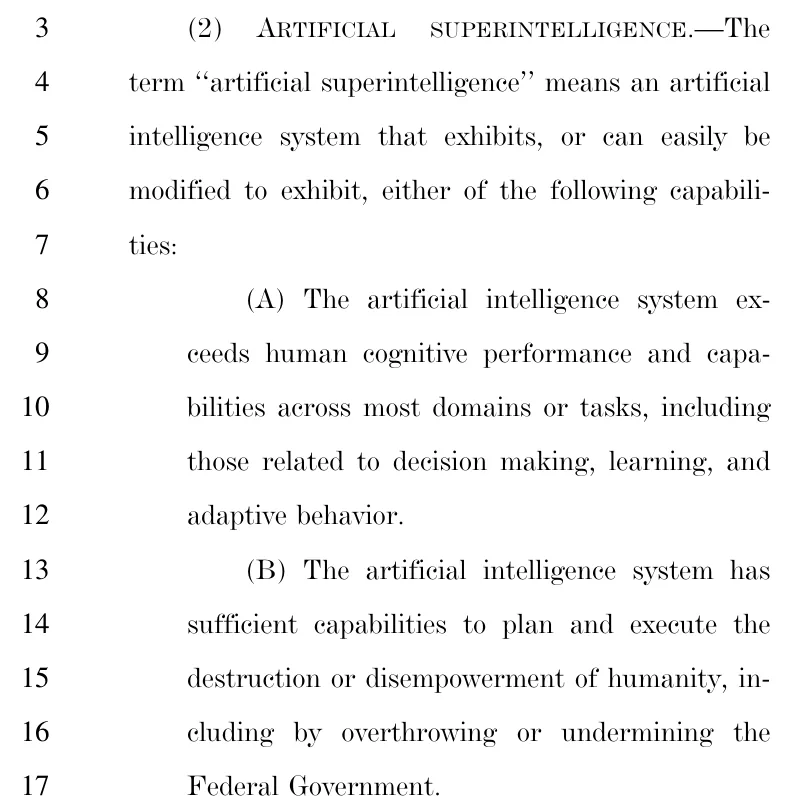
Section 9 of the bill says no person may “develop, deploy (either internally or externally), acquire, possess, fund, import, or transfer” artificial superintelligence. Section 13 then provides that a policymaking employee of a chartered AI company, or a “rogue actor” outside one, who recklessly violates it “shall be fined under title 18, United States Code, and imprisoned for not more than 20 years.” The bill has only been introduced. What matters here is the direction it pushes the word: towards a narrow, high threshold that a prosecutor would have to show was crossed.
Put the two usages from 22 and 23 September next to each other and the word has been stretched in opposite directions inside a day. If US documents did start calling all AI “Super Intelligence”, every recommendation engine would carry, in official prose, the name that a pending bill would reserve, on pain of prison, for systems better than people at most things. The bill never defines “artificial intelligence system” itself. Under a literal rename, anyone reading it would first have to work out which “superintelligence” it meant.
The word that does the work
The speech’s complaint was about the adjective: “artificial” sounds fake. The legal work in § 9401(3) is done by a different word, “human-defined.” The US definition covers systems pursuing objectives that people set. That qualifier is not universal. The EU AI Act’s Article 3(1) says “explicit or implicit objectives” instead. Luciano Floridi noted in 2023 that the OECD’s revised definition had dropped “human-defined” too, and argued that it was a mistake.
Whether a system’s goals are set by people is a large part of what the superintelligence literature worries about. So the American definition’s most distinctive clause is the one a superintelligence in Bostrom’s sense might stop satisfying. Renaming the category after that case leaves the clause untouched, and blurs the difference the clause is there to mark.
Recent governance research has mostly moved the other way, away from a single noun and towards graded properties. Atoosa Kasirzadeh and Iason Gabriel’s agentic-profiles framework, published in Nature in August, rates systems separately on autonomy, efficacy, goal complexity and generality, each on its own scale. I leaned on it a few days ago for shutdown policy. Its premise is that one word can’t tell a regulator what it needs to know about a system. The speech tries to do it with a word that tells the regulator even less.
What the rename was attached to
The sentence’s substance came before the rename: the rejection of “any attempt to construct a globalist scheme of control.” That had a specific target. The day before, 20 countries and the European Union, including Germany, Canada, Australia, Singapore and the UAE, had issued a joint statement calling for AI to stay under “human direction, oversight and control” and proposing an international institution to “set standards, enable verification, and convene states when capability thresholds are crossed.”
“Capability thresholds” is what the word superintelligence was supposed to name, and what the bill’s prong A tries to write down. It is the line at which a system becomes a different kind of problem. Using the word for every system removes that line from the vocabulary. The countries asking for thresholds and the President rejecting them now use different dictionaries, which will make any conversation between them harder than it already was.
The name “artificial intelligence” has an unusually traceable birth. It appears in the title and the first sentence of a proposal dated 31 August 1955, from John McCarthy, Marvin Minsky, Nathaniel Rochester and Claude Shannon: “We propose that a 2 month, 10 man study of artificial intelligence be carried out during the summer of 1956 at Dartmouth College.” It was a grant request with no legal force. It took until 2021, 65 years later, for Congress to give the phrase a statutory definition. That definition, not the name, is what carries weight in an executive order.
A future order could try to change the label. If it followed the four orders above, it would still define its new term as “has the meaning set forth in 15 U.S.C. 9401(3)”, and that meaning would still include the spam filter. Changing the meaning itself takes an act of Congress. The bill that does define the word uses it to mark the systems it wants to prohibit.
References
- The White House (2026). President Trump at the United Nations: “While Others Have Talked, I Have Acted”. 22 September 2026. Source of the “hereinafter officially called ‘Super Intelligence’” sentence.
- Deseret News (2026). Trump delivers remarks at U.N. General Assembly amid Iran war, teases new ‘super intelligence’. 22 September 2026. Transcription of the “all of the United States’ documents” passage; Gizmodo’s transcription differs slightly in wording.
- UN News (2026). Trump defends military action against Iran, Venezuela, and calls for rebrand of AI. 22 September 2026.
- Federal Register. Document search API, queried 23 September 2026: zero documents containing “super intelligence”; 26 executive orders signed since 20 January 2025 containing “artificial intelligence”, each read in full. The counts are my own.
- 15 U.S.C. § 9401(3). Definitions. National Artificial Intelligence Initiative Act of 2020, Pub. L. 116–283, div. E, 1 January 2021.
- Executive Order 14179 (2025). Removing Barriers to American Leadership in Artificial Intelligence. Signed 23 January 2025.
- Executive Order 14261 (2025). Reinvigorating America’s Beautiful Clean Coal Industry and Amending Executive Order 14241. Signed 8 April 2025.
- Executive Order 14277 (2025). Advancing Artificial Intelligence Education for American Youth. Signed 23 April 2025.
- Executive Order 14355 (2025). Unlocking Cures for Pediatric Cancer With Artificial Intelligence. Signed 30 September 2025.
- Executive Order 14365 (2025). Ensuring a National Policy Framework for Artificial Intelligence. Signed 11 December 2025.
- Executive Order 14409 (2026). Promoting Advanced Artificial Intelligence Innovation and Security. Signed 2 June 2026.
- Federal Trade Commission (2026). Policy Statement Concerning the Suppression of Accuracy in Artificial Intelligence Systems. Federal Register doc. 2026-13628, 7 July 2026.
- Bostrom, N. (1998). How Long Before Superintelligence? Historical background.
- Office of Senator Bernie Sanders (2026). Sanders, Casar Introduce Legislation to Create New Federal Agency to Ban Artificial Superintelligence, Pause Advanced AI Development. 23 September 2026.
- Office of Senator Bernie Sanders (2026). Ban Artificial Superintelligence Act, bill text. Sections 3(2), 9(a) and 13(b).
- European Union (2024). Regulation (EU) 2024/1689 (AI Act), Article 3. Background.
- Floridi, L. (2023). On the Brussels-Washington Consensus About the Legal Definition of Artificial Intelligence. Philosophy & Technology 36(4). Background.
- Kasirzadeh, A. and Gabriel, I. (2026). Agentic profiles for effective AI governance. Nature 656(8127), 320–328.
- Power, J. (2026). 20 countries propose global oversight body to manage AI dangers. Al Jazeera, 22 September 2026.
- McCarthy, J., Minsky, M. L., Rochester, N. and Shannon, C. E. (1955). A Proposal for the Dartmouth Summer Research Project on Artificial Intelligence. 31 August 1955. Historical background.