On 22 September, Latent Space’s weekday AI newsletter ran the headline “Xiaomi MiMo-V2.6-Pro 1T-A42B: the new top Open Weights model, trained for $3M.” That is a trillion-parameter mixture-of-experts model with 42 billion parameters active per token, released under an MIT license, and the phrase “trained for $3M” is the kind that travels. A day later, a MindStudio write-up put the cost at “around $3.5 million.”
Neither number appears in Xiaomi’s technical report. The report contains one dollar sentence, in section 4.1: “We scale RL computation across thousands of GPUs in a single run, spending $2.6M and $0.9M on RL post-training for MiMo-V2.6-Pro and MiMo-V2.6-Flash, respectively.” The $3M headline looks like the first figure rounded up, and the $3.5M looks like the two models added together. Both are reinforcement learning costs only. Both leave out the stage that usually costs the most.
What the $2.6M covers
A model like this is built in stages. First comes pretraining, where the model reads a very large pile of text, and here images and audio too. Then there is a mid-training stage that extends context and adds agentic skills, a short supervised fine-tuning pass, and finally reinforcement learning (RL), where the model attempts tasks, gets graded, and is updated towards what worked. The report is specific about the size of the first stage: MiMo-V2.6-Pro “is trained on 30T tokens,” 27 trillion of them text and 3 trillion multimodal. It says nothing about what that stage cost. It names no GPU model, no GPU-hours and no price per hour, for pretraining or for anything else.
So the $2.6M is the bill for the last stage. Inside that stage the report is unusually open. Figure 3 splits the Pro run’s cost three ways: 43.8% on rollout (generating attempts), 43.5% on training (the gradient updates), and 12.7% on the grader, a separate agentic judge that scores long coding attempts instead of relying on pass/fail tests alone. Figure 12 gives the run’s wall-clock time as 123.1 hours over 30 training steps, a little over five days. That works out to about $87,000 per step, or roughly $21,000 an hour. If you assume the $2-per-GPU-hour rental price DeepSeek used, that is about 10,500 GPUs running continuously. This is my arithmetic on an assumed price, not Xiaomi’s, but it is consistent with the report’s “thousands of GPUs.”
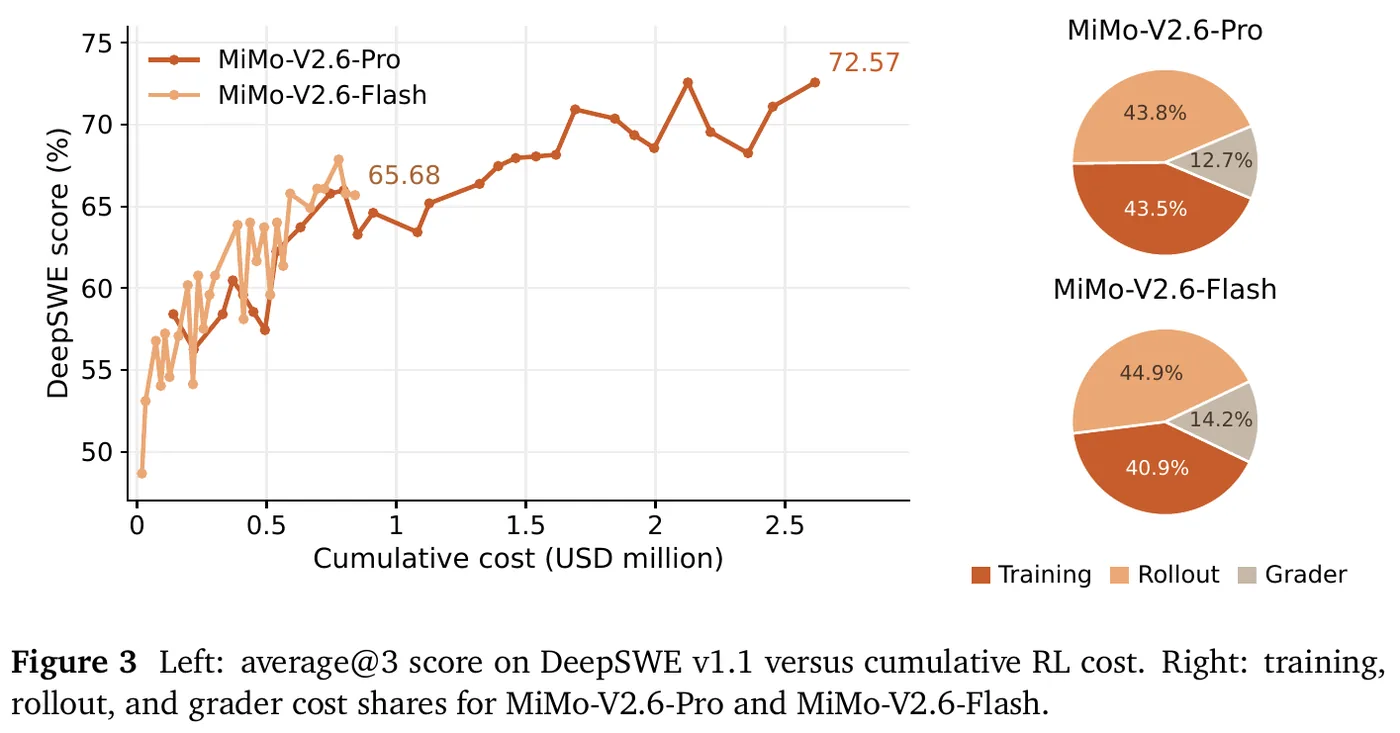
The chart also shows what the money bought. Over the run, the Pro model’s DeepSWE score went from 58.4 to 72.6. Reading the curve by eye, about 71 was already reached at roughly $1.7M, so the last third of the spend moved the score by less than two points. The curve also dips along the way. It touched 72.6 near $2.1M, fell to about 68 at $2.35M, and climbed back. RL curves are noisy, and a lab that publishes its noisy curve is doing better than most. But “trained for $3M” makes the money sound like the price of a model. It is really the price of the last fourteen points on one benchmark.
The number the report doesn’t give
What would the missing stage cost? Nobody outside Xiaomi knows. The report gives enough to make an order-of-magnitude guess, though, and the obvious yardstick is the report that made cheap-training headlines in the first place.
DeepSeek-V3’s technical report, from December 2024, did its accounting the transparent way. Its Table 1 lists H800 GPU-hours for each stage (2,664K for pretraining, 119K for context extension, 5K for post-training), multiplies by an explicitly assumed $2 per GPU-hour, and arrives at $5.576M. It also says what the figure excludes: “prior research and ablation experiments on architectures, algorithms, or data.” That $5.576M got its own round of “trained for $6M” headlines, which were also wrong, but anyone could see the working.
The standard rough estimate of training compute is six times active parameters times tokens. DeepSeek-V3 had 37 billion active parameters and 14.8 trillion pretraining tokens, which gives about 3.3 × 10²⁴ operations. MiMo-V2.6-Pro, at 42 billion active and 30 trillion tokens, gives about 7.6 × 10²⁴, roughly 2.3 times as much. At DeepSeek’s 2024 efficiency and price, Pro’s pretraining would cost around $12M. That estimate has large error bars in both directions. Xiaomi may be on newer hardware (a Latent Space summary of commentary on X mentions TPUs, which the report does not confirm), the multimodal stage runs through vision and audio encoders the formula ignores, and hardware prices have moved in almost two years. But even if the true figure were half of that, pretraining would still be the larger bill. On my estimate, the $2.6M is somewhere around a sixth of the direct compute, before any mid-training, ablations or failed runs.
Why the small number still matters
Here is where I end up disagreeing with my own complaint. The headline got the scope wrong, but the $2.6M matters on its own terms, and its history shows why.
In DeepSeek-V3’s December 2024 accounting, post-training was a rounding error: 5K GPU-hours, $0.01M, against $5.328M for pretraining. Nine months later DeepSeek published R1 in Nature, and its supplementary Table 4 costed the reasoning stage for the first time. R1-Zero’s RL took 101K H800 GPU-hours ($202K), R1 took 41K ($82K), and SFT data creation took 5K ($10K), for $294K in total, again at $2 an hour. Now, a year after that, one lab reports $2.6M for a single RL run. That is about 260 times V3’s post-training line and about nine times R1’s entire reasoning budget.
That shift is what the MiMo report is mostly about, and the $3M framing buries it. Not long ago, “how much did it cost to train” meant pretraining, and post-training was the cheap finishing work. The MiMo report is built around the opposite idea. Its title is “Scaling Reinforcement Learning Towards Self-Improvement,” and it argues that RL compute can be scaled on three axes: bigger batches (1,568 prompts per step, 2.7 to 3.7 billion tokens), more environments, and more grader compute. The run is big enough to break in ways small runs don’t. In a run where the mixture-of-experts router was left trainable, load collapsed within 20 steps: at one layer the busiest expert’s load went from 6 to 16 times the mean. The team froze the router for RL. The Pro run was restarted after the grader “became unreachable over the network after step 14.” Anyone who has run a large job will recognise the problem, even if they have never trained a model.
One detail from the commentary needs correcting. A post on X, as summarized in the Latent Space issue, put the run at 130 hours, 75 billion tokens and $2.6M. The report’s own figure is 123.1 hours, which is close. Its per-step token range, though, puts 30 steps at 81 to 111 billion tokens, so the 75B figure is below the report’s own floor. That suggests the commentary was working from something other than the report.
I have written before that a multiple is only as honest as its denominator, and this story is the dollar version of that point. DeepSeek’s $5.6M was misread too, but the misreading could be checked, because the GPU-hours and the price were on the page. Xiaomi’s $2.6M is harder to check. It is a figure with no hours, no hardware and no price assumption, attached to one stage, sitting next to a 30-trillion-token stage with no figure at all. The report open-sources the RL framework, the environments and the training dynamics, which is generous. A table of GPU-hours would cost less than any of that. The report also has a small courtesy of its own: its contributor appendix notes that “within each role, authors are listed in reverse alphabetical order by first name.” A report that explains how it sorted its authors could also say how it counted its dollars.
Until it does, here is how I would read the headline: MiMo-V2.6-Pro was not trained for $3M. Its last stage cost $2.6M, and even that last stage now costs more than all of R1’s reasoning training did.
References
- Xiaomi LLM-Core (2026). MiMo-V2.6: Scaling Reinforcement Learning Towards Self-Improvement. Technical report, Hugging Face, 22 September 2026. §3.1 (pretraining tokens), §4.1 and Figure 3 (RL cost and cost shares), Figure 11 (router load), §5.5 and Figure 12 (failures and elapsed time), Appendix A (author ordering).
- Xiaomi MiMo (2026). MiMo-V2.6-Pro-RL model card. Hugging Face, 22 September 2026. 1.02T total / 42B active parameters, MIT license.
- Latent Space (2026). [AINews] Xiaomi MiMo-V2.6-Pro 1T-A42B: the new top Open Weights model, trained for $3M. 22 September 2026.
- Chavez-Mattos, L. (2026). MiMo-V2.6 open model release. MindStudio, 23 September 2026.
- DeepSeek-AI (2024). DeepSeek-V3 Technical Report. arXiv:2412.19437, December 2024. Table 1, training costs at $2 per H800 GPU-hour.
- DeepSeek-AI (2025). DeepSeek-R1 incentivizes reasoning in LLMs through reinforcement learning. Nature 645, 633–638, 17 September 2025. Supplementary Information §2.4.4 and Table 4, training costs.