Last year I took a 30x whole-genome DNA test. A 30x test reads nearly every letter of the roughly 3-billion-letter human genome an average of 30 separate times. My file came back with 6,695,003 places where my DNA differs from the standard reference genome.
The ancestry reports that came with it were close to useless. The paternal report stopped at one broad letter, J, a branch shared by hundreds of millions of men from Iberia to Bengal. The maternal report crashed with a pipeline error and returned nothing.
The raw file was still there, so I read it myself. I checked it against three public references: PhyloTree Build 17 for the maternal tree, the ISOGG and YFull trees for the paternal one, and the ancient-DNA panels published by David Reich’s lab at Harvard. That recovered both lineages, with every step checked against the actual reads, and it turned up a third story that neither lineage could show on its own.
A family question
Both sides of my family have roots in Maharashtra and on India’s western Konkan coast. My father’s family is Maratha. My mother’s family is Brahmin.
When I pulled my mother’s unbroken mother-to-daughter DNA out of the raw file, it was M30g, an ancient Indian lineage that has been inside South Asia for about 55,000 years, or more than 1,800 generations. Yet the rest of my genome also carries ancestry from Bronze Age herders who lived on the grasslands of today’s Ukraine and southern Russia only about 5,000 years ago.
Both are true at once. The explanation comes down to the difference between the two small pieces of DNA that never get shuffled and the 98% that do.
How DNA keeps a record
Most of your DNA sits on 22 numbered pairs of chromosomes called autosomes. Think of them as two decks of cards, one from each parent, shuffled together every generation. You get half from your mother and half from your father, cut and spliced at random. That is why siblings resemble each other without being identical. It also means that after fifty or a hundred generations, any one ancestor’s contribution has been cut into small pieces.
Two pieces of DNA skip the shuffle.
- Mitochondrial DNA (
mtDNA) is a small ring of 16,569 letters, about 0.0005% of your DNA. It passes intact from a mother to all her children, and only daughters pass it on. Each cell holds hundreds of mitochondria, so a 30x test reads this ring far more often than the rest of the genome. My file read it at an average depth of 248.1x. - The Y chromosome (
Y-DNA) passes intact from father to son. Men carry one copy instead of two, so a 30x test reads it at about half the usual depth. Mine came in at 14.8x.
Every so often, when a cell copies one of these unshuffled pieces, a harmless one-letter typo slips in. An A becomes a G at position 10,398, say. Every descendant down that branch inherits that typo plus every earlier one. They work like stamps in a passport, added in order and never removed. Match your stamps to dated ancient skeletons from caves, river valleys and Bronze Age graves, and a text file turns into a route across a map.
Stream 1: my mother’s line, mtDNA M30g
The consumer app failed on my mitochondrial DNA, but the raw file had 31 high-confidence (PASS) calls on the mitochondrial genome at 248.1x average depth, with better than 99.9% purity at each call. Every stamp on the way to M30g was there. Here is the route, by modern country.
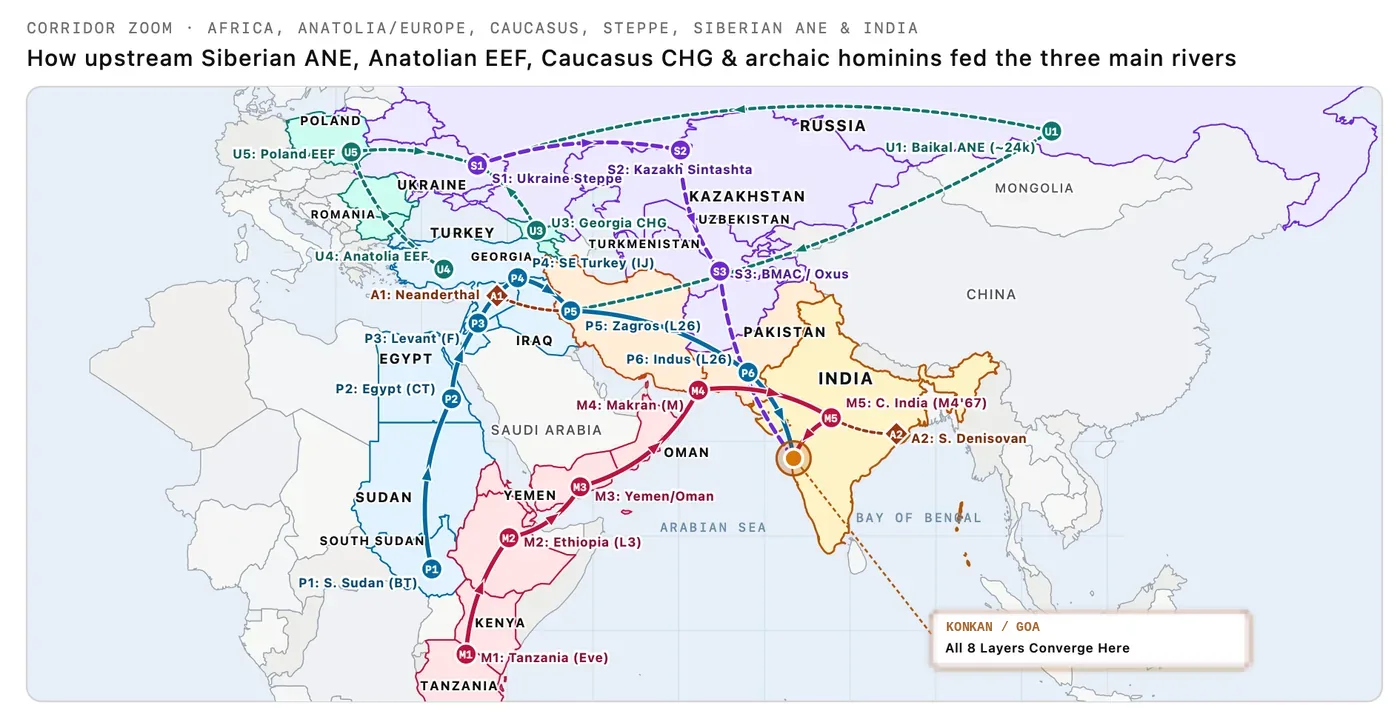
- Tanzania and Kenya, about 175,000 years ago. Every living person’s maternal line meets in the East African Rift Valley, in the woman geneticists call Mitochondrial Eve (haplogroup
L). - Ethiopia, about 70,000 years ago. One branch picked up the changes that define
L3, the mother branch of every maternal line outside Africa. - Djibouti to Yemen and Oman, about 65,000 to 60,000 years ago. During a glacial period, sea level was about 80 meters lower than today. The Bab el-Mandeb strait at the mouth of the Red Sea narrowed to roughly 10 to 15 km, and coastal groups crossed into southern Arabia. Along the way the line became
M. My file carries all three of its defining stamps:m.489T>C,m.10398A>Gandm.10400C>T. - Southern Iran and Pakistan, about 58,000 to 55,000 years ago. They followed the shoreline along the Makran coast of Balochistan and reached India about 55,000 years ago. Geneticists call these people the First Indians.
- Central India to Maharashtra and the Konkan, about 40,000 to 12,000 years ago. Inside India the line picked up
m.12007G>A(M4'67, about 40,000 years ago), thenm.195T>Candm.15431G>A(M30, about 28,000 years ago, during the Ice Age), and finallym.6119C>T, which definesM30g. My file read that last position 214 times in a row with no conflicting reads.
Since then, for more than 1,800 generations, this mother-to-daughter line has stayed in India. It was there long before farming existed anywhere on Earth.
Stream 2: my father’s line, Y-DNA J2a1-L26
On the Y chromosome I kept only clean single-copy reads at the highest mapping quality (MQ = 60), which left 3,710 PASS calls at 14.8x depth. Walking down the tree one stamp at a time took the app’s vague J to J2a1-L26, confirmed by rs17250845 G>C at chrY:21,152,995.
- South Sudan and Sudan to Egypt, about 230,000 to 70,000 years ago.
BTtoCT-M168. While my mother’s ancestors took the southern exit across the Red Sea, my father’s went north along the Nile and out over the Sinai land bridge. - Israel, Jordan, Lebanon and Syria, about 55,000 to 48,000 years ago. In the Mediterranean Levant the line became
F-M89and thenIJK. - Southeastern Turkey and northern Iraq, about 45,000 years ago.
IJ-M429, in upper Mesopotamia. HereIsplit off northwest into Ice Age Europe.Jstayed in the Fertile Crescent. - Western Iran’s Zagros Mountains, about 30,000 years ago to 7,500 BCE.
J-M304toJ2-M172toJ2a-M410toJ2a1-L26. These mountain communities became some of the world’s first barley and wheat farmers and goat herders, at sites like Ganj Dareh (Lazaridis et al., 2016). - Pakistan to western India, about 6,000 to 1,800 BCE.
J2a1-L26spread east across Iran into Pakistan: Mehrgarh, then the Indus Valley cities of Harappa and Mohenjo-daro. As the monsoons weakened around 2,000 to 1,800 BCE, settlement moved south through Gujarat (Lothal, Dholavira) and down into Maharashtra and the Konkan coast.
That puts my father’s line in western India about 45,000 years after my mother’s line had already arrived.
Stream 3: the Steppe in the shuffled DNA
The two single lines leave out almost everyone. Go back 20 generations and you have about a million ancestral slots. My mother’s line follows one of them, and my father’s line follows another. The rest are only in the 22 shuffled autosomes, which hold more than 98% of my DNA.
Read at 30x across those autosomes, my file carries variants that spread through Bronze Age populations of the western Steppe and Europe. One derived copy at TLR1 (rs4833095 T/C) is an innate-immunity variant that swept through Steppe and European populations. Two derived copies at FADS1 and FADS2 (rs174546 C/C, rs174570 C/C) mark a fat-metabolism sweep tied to Bronze Age herding and farming diets. Both sweeps are traced in ancient genomes by Mathieson et al., 2015. On their own, two markers prove little. They fit a pattern that ancient-DNA studies have mapped in detail across South Asia.
How it got in without touching my mother’s line
Three papers explain the mechanism: Narasimhan et al., 2019 in Science, Silva et al., 2017 and Moorjani et al., 2013.
The route, about 3,000 to 1,500 BCE. It starts with the Corded Ware people of the forest-steppe in today’s Ukraine, Belarus, Poland and southern and western Russia. It runs east to the southern Urals and Kazakhstan, where the Sintashta culture built the first spoked-wheel chariots and the Andronovo culture followed. From there it runs south through Uzbekistan, Turkmenistan, Tajikistan and Afghanistan into northwestern India, and on to Maharashtra and the Konkan.
Mostly men. Somewhere between 70% and 90% of the Steppe migrants who entered South Asia were men. They married women already living in India, women carrying old Indian maternal lines like M30g. Fathers don’t pass on mitochondrial DNA, so the maternal line stayed 100% Indian. The newcomers’ contribution went into the shuffled autosomes instead, where it is still measurable across many communities in north and west India today.
About 2,000 years of endogamy. From roughly 2,000 years ago, marriage within the same community became the norm (Moorjani et al., 2013). That froze the mix in place. Steppe ancestry from the Bronze Age, farmer ancestry from the Zagros and the Indus, and a maternal line that had been in India for 55,000 years all ended up side by side in the same families.
So the question has a simple answer. My mother’s maternal line came from the First Indians. Part of her shuffled DNA came, through many generations of fathers, from the Bronze Age Steppe. Both live in one genome, on different parts of it.
Six stops, one couple
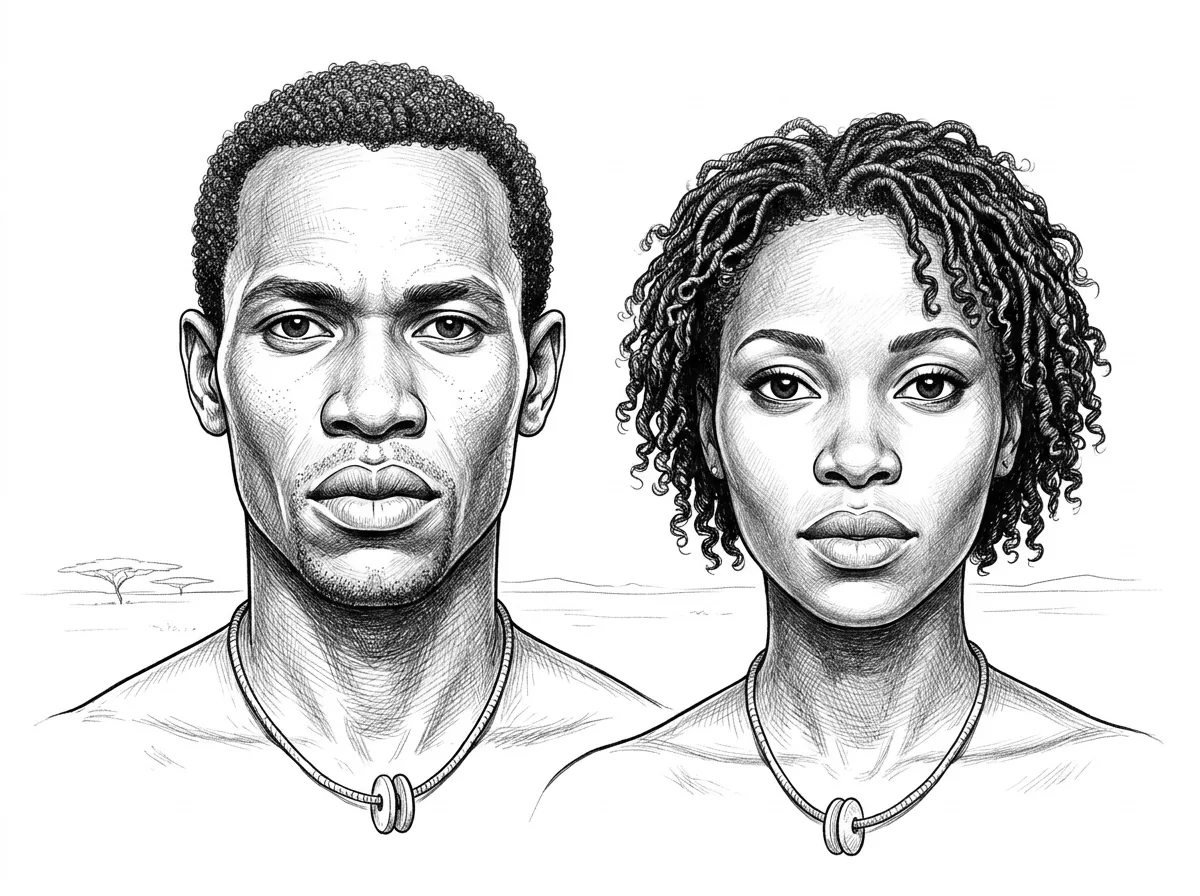
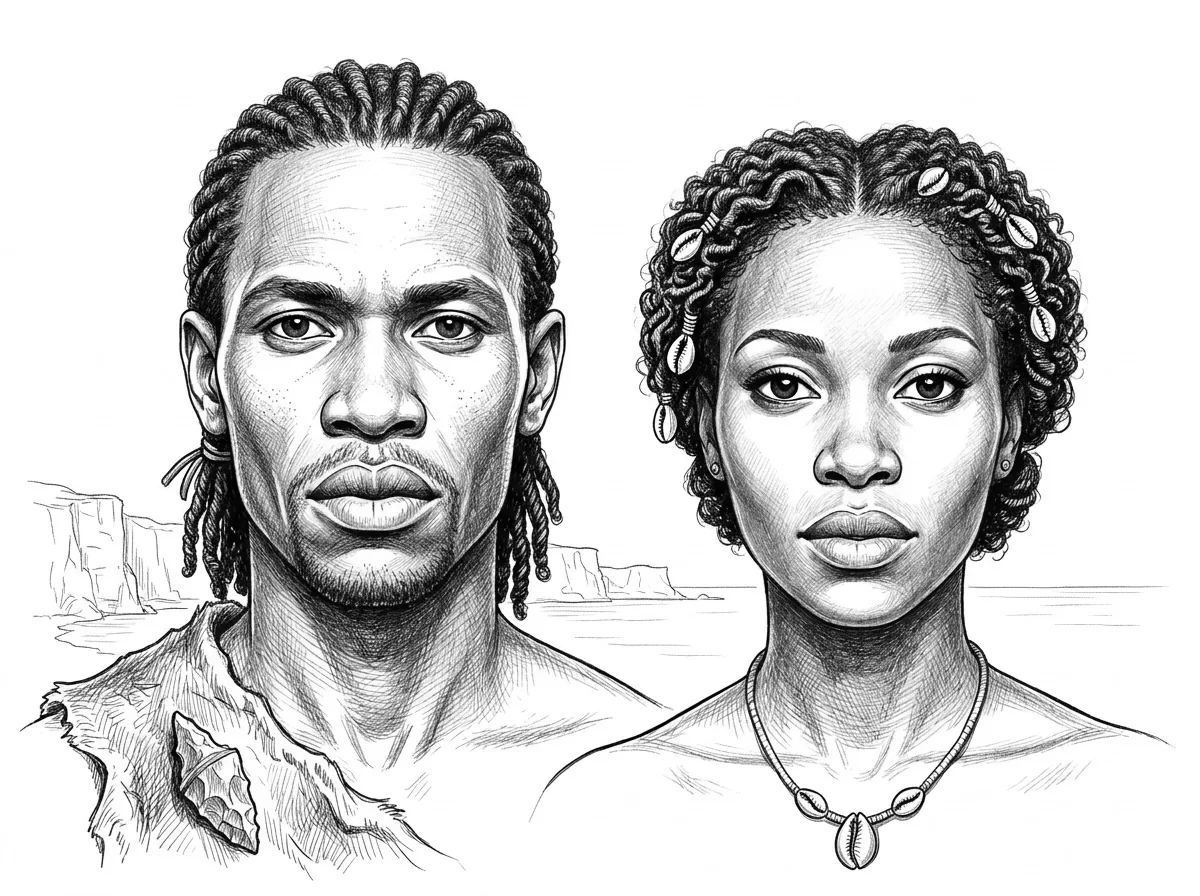
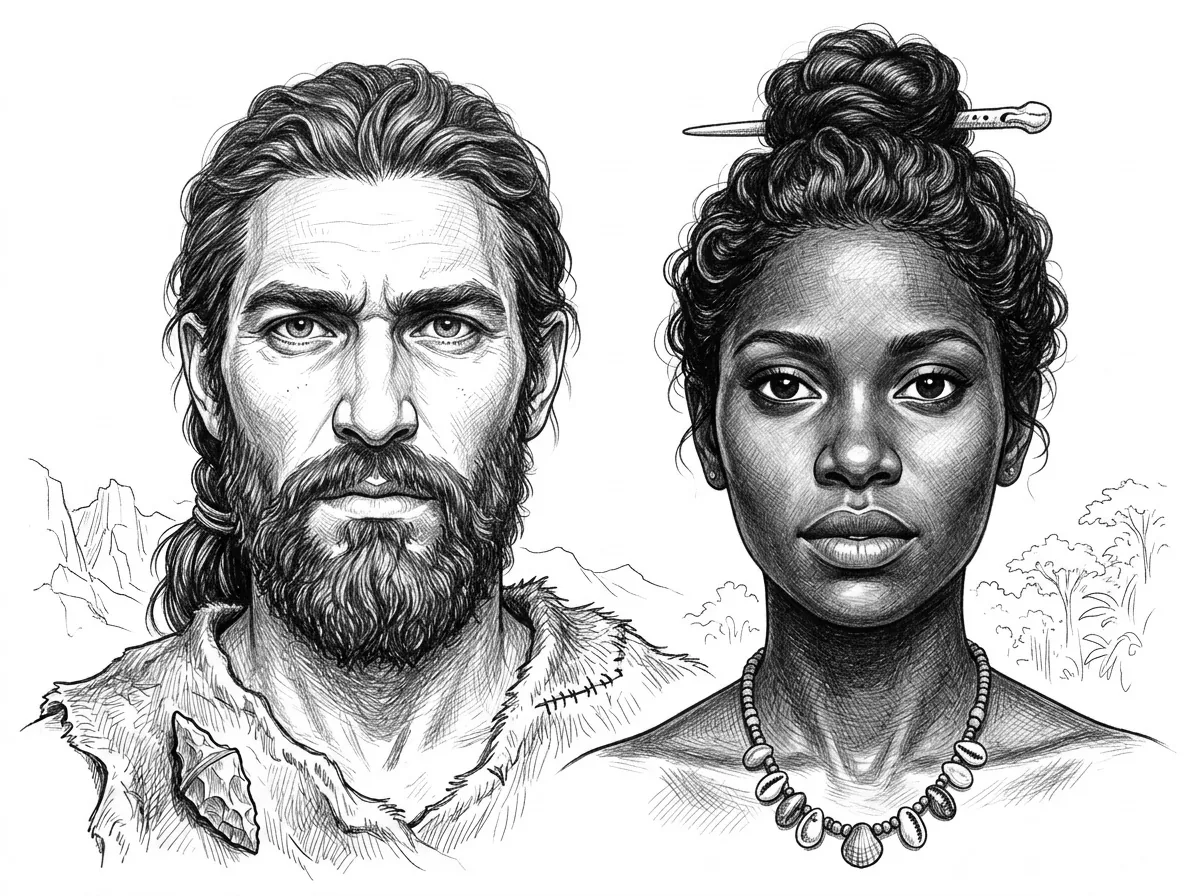
I had six graphite-and-ink studies drawn to mark the stops along these routes. Each shows the same man (left) and woman (right) at the same eye level, so what changes is the place, the era, the hairstyles, the ornaments and the landscape behind them. They are illustrations, not reconstructions of real people.
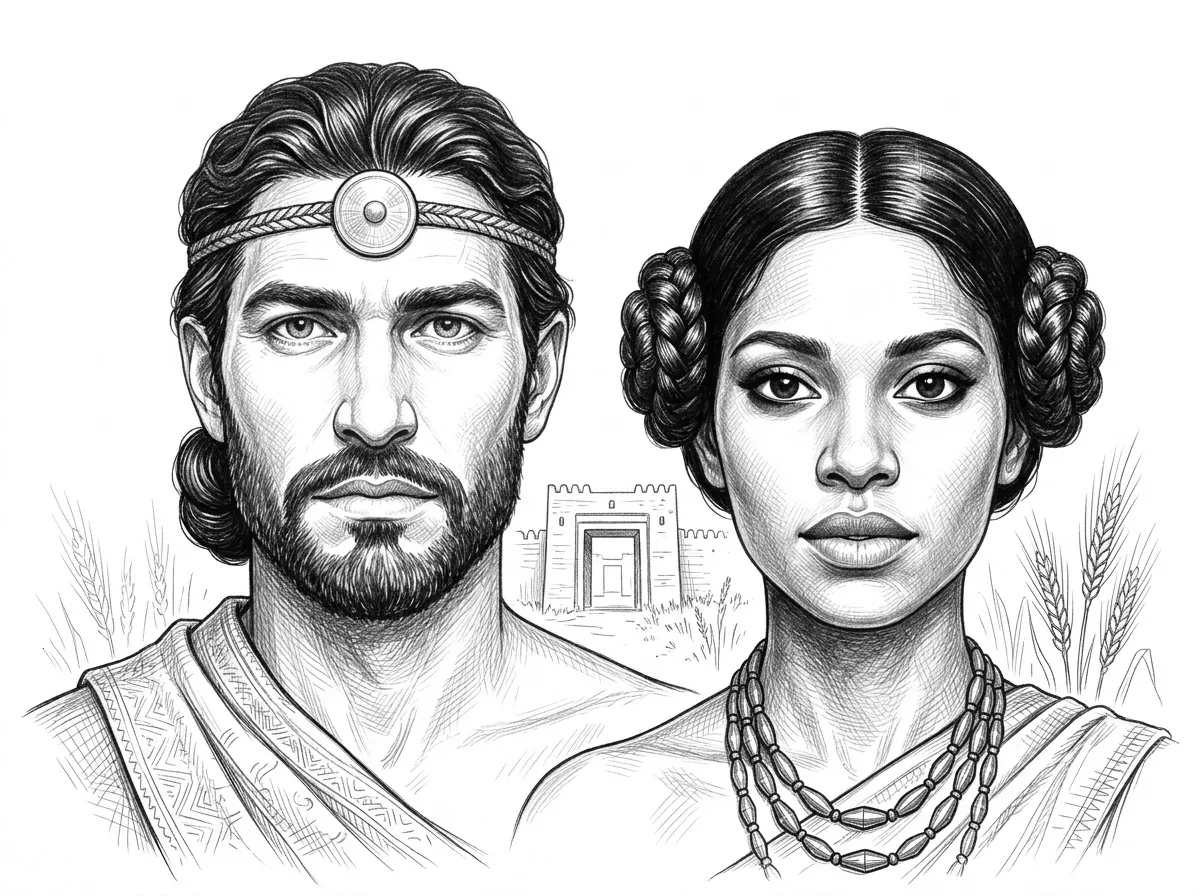


By modern country
| Stream | Where it lives | Read depth | Route |
|---|---|---|---|
Maternal, M30g |
Mitochondrial DNA, 16,569 letters, mother to child | 248.1x, 31 PASS calls, m.6119C>T read 214 times |
Tanzania and Kenya, Ethiopia, Djibouti, Yemen, Oman, southern Iran, Pakistan (Makran), India (central India to Maharashtra and the Konkan), United States |
Paternal, J2a1-L26 |
Y chromosome, father to son | 14.8x, 3,710 PASS calls at MQ = 60, rs17250845 G>C |
South Sudan and Sudan, Egypt, Israel, Jordan, Lebanon and Syria, Turkey and Iraq, Iran (Zagros), Pakistan (Indus Valley), India (Gujarat to Maharashtra and the Konkan), United States |
| Autosomal Steppe | 22 shuffled autosomes, about 98% of DNA | 30x genome-wide | Ukraine, Belarus, Poland and southern Russia, Kazakhstan, Uzbekistan, Turkmenistan, Tajikistan and Afghanistan, northwestern India, Maharashtra and the Konkan, United States |
What I took from it
First, consumer ancestry summaries throw away most of what you paid for. My 30x file already had about 250x coverage of the mitochondrial genome, about 15x on the Y chromosome and millions of exact read counts on the autosomes. When the app gave me one letter and a crash, the data was fine. Only the summary failed.
Second, the single lines and the shuffled autosomes answer different questions. If I had looked only at M30g, I would have concluded that my mother’s ancestry never touched the Steppe in 55,000 years. If I had looked only at the autosomes, I would have missed 1,800 generations of Indian foremothers. It took all three to see what actually happened: Bronze Age migrants who were mostly men, and two thousand years of marrying within the community, wrote both stories into the same family. All three streams now live in one genome in the United States.
References
- Narasimhan, V. M., Patterson, N., Moorjani, P. et al. (2019). The formation of human populations in South and Central Asia. Science, 365(6457), eaat7487.
- Mathieson, I., Lazaridis, I., Rohland, N. et al. (2015). Genome-wide patterns of selection in 230 ancient Eurasians. Nature, 528, 499–503.
- Lazaridis, I., Nadel, D., Rollefson, G. et al. (2016). Genomic insights into the origin of farming in the ancient Near East. Nature, 536, 419–424.
- Silva, M., Oliveira, M., Vieira, D. et al. (2017). A genetic chronology for the Indian Subcontinent points to heavily sex-biased dispersals. BMC Evolutionary Biology, 17, 88.
- Moorjani, P., Thangaraj, K., Patterson, N. et al. (2013). Genetic evidence for recent population mixture in India. American Journal of Human Genetics, 93(3), 422–438.
- van Oven, M., & Kayser, M. (2009). Updated comprehensive phylogenetic tree of global human mitochondrial DNA variation. Human Mutation, 30(2), E386–E394. (PhyloTree Build 17.)